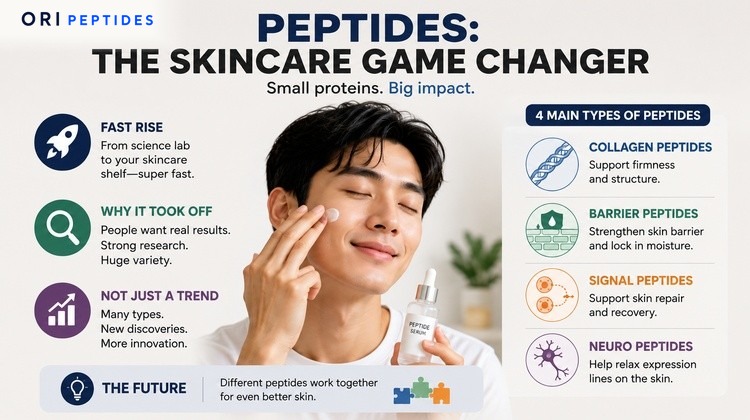
Peptides in skincare moved faster than almost any other ingredient category. Skincare does not usually move fast. Retinol took decades to go from dermatology offices to drugstore shelves. Vitamin C had a similarly slow climb into the mainstream. Peptides did something different. They went from a niche, science-forward ingredient category to a shelf staple across nearly every price tier in a fraction of the time.
That speed is the real story here. Understanding why peptides moved so quickly says a lot about where skincare research is headed next. This content is provided for Research Use Only (RUO).
Why Peptides Fit the Moment
A few things lined up to make peptides skincare’s breakout research category.
- Skincare shoppers were already trained to ask “how does this work.” Retinol and vitamin C had already shifted skincare culture toward active ingredients, meaning ingredients chosen for a specific, studied effect rather than a general marketing claim. That primed shoppers to look past the label and ask about the actual mechanism behind a product.
- Peptides had a research head start. Unlike some skincare trends that start from a single splashy study, peptide research on skin structure had been building in dermatology and cosmetic science literature for years before the mainstream beauty industry caught on.
- The category is genuinely broad. “Peptides” is not one ingredient. It is a category made up of dozens of distinct compounds, each studied for a different skin-structure mechanism. That breadth gave brands an unusually large runway to keep launching new peptide-based products without running out of genuine research angles.
Our guide on peptides for skin and what current research examines goes deeper into the mechanisms behind this category.
The Categories Getting the Most Research Attention
Cosmetic science usually groups skincare peptides by how they’re thought to work. The main categories are:
- Signal peptides. The most established category, and the one most people picture when they hear “peptide” in skincare. These are short peptide sequences studied for how they signal skin cells called fibroblasts to produce more collagen, the protein that gives skin its structure, strength, and elasticity. Collagen breakdown over time is a major driver of visible skin aging. Palmitoyl pentapeptide-4 is one of the best-known examples.
- Carrier peptides. These are studied for delivering trace minerals such as copper into skin tissue, where those minerals support enzymes involved in repair. GHK-Cu, also listed on labels as copper tripeptide-1, is the classic example.
- Neurotransmitter-inhibiting peptides. Perhaps the most mechanistically distinct category. These are studied for their interaction with the same nerve-signaling pathway that botulinum toxin, better known as Botox, works through: the release of acetylcholine, the neurotransmitter that triggers small muscle contractions at the skin surface, the kind of repeated movement linked to expression lines. Topical peptides in this category act far more mildly than an injected toxin. Acetyl hexapeptide-8 is a commonly cited example.
- Barrier-support peptides. A newer research focus centered on the skin barrier, the outermost layer of skin that protects against water loss and outside irritants. These compounds are studied for their role in barrier structure and how skin retains moisture.
What Makes This Different From a Typical Ingredient Trend
Most skincare ingredient trends follow a familiar pattern. One compound gets attention, brands rush to include it, and interest fades once the next ingredient trend arrives. Peptides broke that pattern for one specific reason: the category never consolidated around a single compound. New peptide sequences are still being researched and introduced regularly, which means the category keeps generating fresh research angles instead of running out of new ground the way single-ingredient trends typically do.
That is also why peptides have held their position on ingredient lists far longer than most trending actives. There is structurally more research territory left to explore within the category itself.
Our piece on the KPV peptide and what the research shows about gut and skin inflammation covers one example of that ongoing research.
Where This Goes Next
The same pattern playing out in metabolic and longevity peptide research, where multiple compound categories converge and inform each other, is starting to show up in skincare research too. Barrier-support research is beginning to draw on methods originally developed for collagen research, and signal peptide research is informing how barrier-focused compounds are being designed. The skincare peptide category is not just growing in size. It is starting to mature in the same cross-informing way other peptide research fields already have.
FAQ
Why did peptides catch on in skincare faster than other ingredients?
Skincare culture had already shifted toward asking how an ingredient works, thanks to retinol and vitamin C, and peptide research on skin structure already had years of dermatology literature behind it by the time the beauty industry caught on.
What is the difference between signal peptides and barrier-support peptides?
Signal peptides are studied for their role in the pathways behind collagen production, which affects skin structure and elasticity. Barrier-support peptides are studied separately for their role in the skin’s outer protective layer and how it retains moisture.
How are neurotransmitter-inhibiting peptides different from the other categories?
They work through a different mechanism entirely. Instead of affecting skin structure or the skin barrier, they are studied for their interaction with the same nerve-signaling pathway involved in small muscle contractions at the skin surface.
Are skincare peptides regulated or tested the same way as drugs?
No. Peptides in finished skincare products are regulated as cosmetic ingredients, so they don’t go through the drug approval process. Research-grade peptides sold for laboratory use are a separate category: they are not cosmetics, are not for human use, and have not been evaluated by the FDA for safety or efficacy in humans.
Research Use Disclaimer
This content is provided for Research Use Only (RUO). The compounds discussed are not drugs, dietary supplements, foods, or cosmetics, and are not intended for human or animal consumption, diagnostic use, or therapeutic use of any kind. They have not been evaluated by the FDA for safety or efficacy in humans. Any research use must be conducted by qualified professionals in a controlled laboratory environment, in accordance with all applicable institutional, local, and federal regulations.
Sources
- Wikipedia. Collagen, its role in skin strength and elasticity.
- Wikipedia. Stratum corneum, the skin’s outer barrier and its role in moisture retention.
- Wikipedia. Botulinum toxin, how it blocks neurotransmitter release at the point where nerves signal muscles to contract.
- Gorouhi F, Maibach HI. Role of topical peptides in preventing or treating aged skin. International Journal of Cosmetic Science. 2009;31(5):327-345.