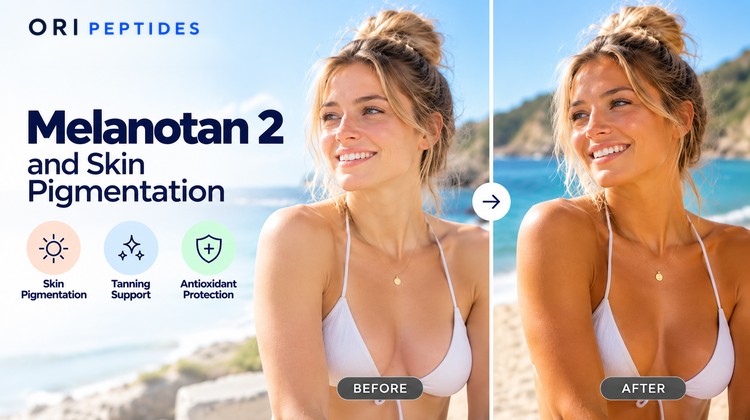
Melanotan 2, also written Melanotan II or MT-II, is a man-made peptide built to copy a natural hormone that darkens the skin. It is best known online as a “tanning jab” and is also talked about for sexual arousal. This guide explains what melanotan 2 is, how it works, what pigment and sexual function research reports, and why its safety record is contested. It describes research only and is not advice for any person.
What Is Melanotan 2?
A peptide is a short chain of amino acids, the building blocks of proteins. Melanotan 2 is a man-made copy of alpha-melanocyte-stimulating hormone, or alpha-MSH. Your body makes alpha-MSH to tell skin cells to produce melanin, the pigment that gives skin and hair its color. According to Wikipedia, melanotan 2 was developed at the University of Arizona in the 1980s as a possible sunless tanning agent.
A 2006 review in the journal Peptides explains that two versions, melanotan I and melanotan II, were patented and tested in clinical studies. Melanotan I was studied for tanning, and melanotan II for male erectile dysfunction. The same Wikipedia entry says melanotan 2 has no FDA approval and is not legally sold as a medicine in any jurisdiction. A 2023 article from the University of New South Wales reports that Australia’s drug regulator, the TGA, says development of melanotan 2 as a medicine was halted some years ago because of safety reasons.
How Melanotan 2 Works
Cells carry docking points called melanocortin receptors. Think of alpha-MSH as a key and each receptor as a lock. Melanotan 2 is a key that fits several locks, not just one. Wikipedia describes it as a non-selective agonist, which means it switches on four types of melanocortin receptor (MC1, MC3, MC4, and MC5).
- Pigment stimulation. A 2015 review in Photochemistry and Photobiology explains that the MC1 receptor on pigment cells responds to alpha-MSH by turning on the enzymes that make eumelanin, the dark brown pigment. A 2021 study in Dermatology says melanotan 2 darkens skin through this same receptor.
- Other effects. Wikipedia says sexual effects are thought to work through the MC4 receptor. Reported effects include facial flushing, nausea, vomiting, stretching, yawning, erections, and loss of appetite.
- Sales status. Melanotan 2 is sold online outside any medical system, as a powder, injection, or nasal spray. A 2017 review in the International Journal of Dermatology says there are open questions about how these products are prepared, given, and dosed. This guide gives no amounts and no how-to steps.
What Pigmentation Research Examines
Melanin is the skin’s own sunscreen. A 2018 review in the International Journal of Molecular Sciences says skin pigment is an important protection against the DNA damage that sun exposure causes. The 2015 review adds that people with red hair often carry a change that switches off the MC1 receptor, so they make less dark pigment and are more prone to skin cancer.
The 2006 review says a “therapeutic tan”, meaning one produced without sun exposure, might lower the risk of skin cancer. It describes this idea mainly for melanotan I.
One related compound did reach the clinic. A 2016 review in the American Journal of Clinical Dermatology reports that afamelanotide, another alpha-MSH copy, is approved in the EU for a rare light sensitivity disorder called erythropoietic protoporphyria. It is given as an implant under medical care. In its phase III trial, treated patients could spend more time in direct sunlight without pain. Common side effects were headache and reactions at the implant site.
Pigment research is real, but afamelanotide is a different compound tested under supervision. No study reviewed here shows that melanotan 2 is a safe way to tan.
See also: Peptides for Skin and What Current Research Examines
What Sexual Function Research Reports
Melanotan 2 was tested for erectile problems in the 1990s. In a 1998 trial in The Journal of Urology, 10 men with erectile dysfunction with no known physical cause received melanotan 2 and a placebo at different times. Erections developed in 8 of the 10 men after melanotan 2. Nausea, stretching, yawning, and lower appetite were reported more often than with placebo.
A follow-up report in 2000 covered 20 men. Erections developed in 17 of them, and increased sexual desire was reported after 13 of 19 doses compared with 4 of 21 placebo doses. Severe nausea was reported after 12.9 percent of doses at the tested level. These were small studies, and a 2014 review says the data warrant further investigation.
A close relative, bremelanotide, went further. A 2020 review in the Annals of Pharmacotherapy reports that it is now an approved treatment for low sexual desire. Reported side effects included nausea (39.9 percent), flushing (20.4 percent), and headache (11 percent), and the authors say the benefit may be modest. It is a different compound, and melanotan 2 itself never reached approval.
Why the Safety Record Is Contested
“Contested” does not mean the warnings are disputed. Health agencies agree that melanotan 2 carries risk. What experts debate is whether some specific harms, such as skin cancer, are proven to be caused by it. Most of the evidence comes from single case reports, which can show a pattern but cannot prove cause.
- Moles and melanoma. The 2017 review in the International Journal of Dermatology says case reports link melanotan use to changes in existing moles and to new atypical moles. It counts four case reports of melanoma growing from existing moles during or soon after use, and says conclusive evidence of a link is lacking. A 2009 case in Archives of Dermatology describes a man with a history of melanoma who developed crops of new moles, which lightened after he stopped. A 2013 report describes new atypical moles within a week of two injections. A 2025 case report describes a young woman who used a nasal spray and developed a melanoma in the lining of the mouth.
- The other side of the debate. Wikipedia notes that reviews have found no conclusive evidence of a melanoma link. It adds that a 2021 review judged the higher melanoma rate among users to be probably explained by extra sun and sunbed exposure.
- Whole-body reactions. A 2012 case describes a man who used a melanotan 2 product bought online and reached an emergency room with a racing heart, anxiety, and muscle breakdown. He was admitted to intensive care. A 2020 case report in CEN Case Reports describes a possible link to a blocked blood supply in the kidney.
- Prolonged erections. Case reports from 2019 and 2021 describe priapism, a painful erection that does not go away. One patient needed surgery, and another had not recovered normal function four weeks later.
- Unknown products. A 2021 study of online forums, covering 623 posts from 205 users, found themes of misinformation, guesswork about amounts, and sunbed use. The 2017 review says several national health bodies have issued warnings.
Overall, the warnings are consistent, the proof of cause for some harms is not, and no one can use this record to name a safe amount.
Handling and Storage
Research melanotan 2 usually arrives as a freeze-dried powder, like most peptides. The supplier’s Certificate of Analysis and handling sheet are the main reference, because they state the exact contents of each vial and the storage conditions. General lab practice is to keep sealed vials as the supplier directs and label every vial with its date and contents. The peptide reconstitution guide explains the general principles for freeze-dried peptides. This guide gives no mixing amounts for melanotan 2, because no peer-reviewed source reviewed here provides any for lab use.
See also: Peptide Reconstitution Ratios & How to Calculate Them
SEXUAL WELLNESS
PT-141
Frequently Asked Questions
Is melanotan 2 the same as melanotan I?
No. The 2006 review describes melanotan I as a linear peptide and melanotan II as a shorter ring-shaped one. Melanotan II switches on more types of melanocortin receptor.
Is melanotan 2 approved?
No. It has no FDA approval, and Australia’s regulator says its development as a medicine was halted for safety reasons.
Does melanotan 2 cause skin cancer?
That is not proven. Case reports describe melanoma and changed moles in users, but reviews say conclusive evidence of a link is lacking.
Is melanotan 2 the same as PT-141?
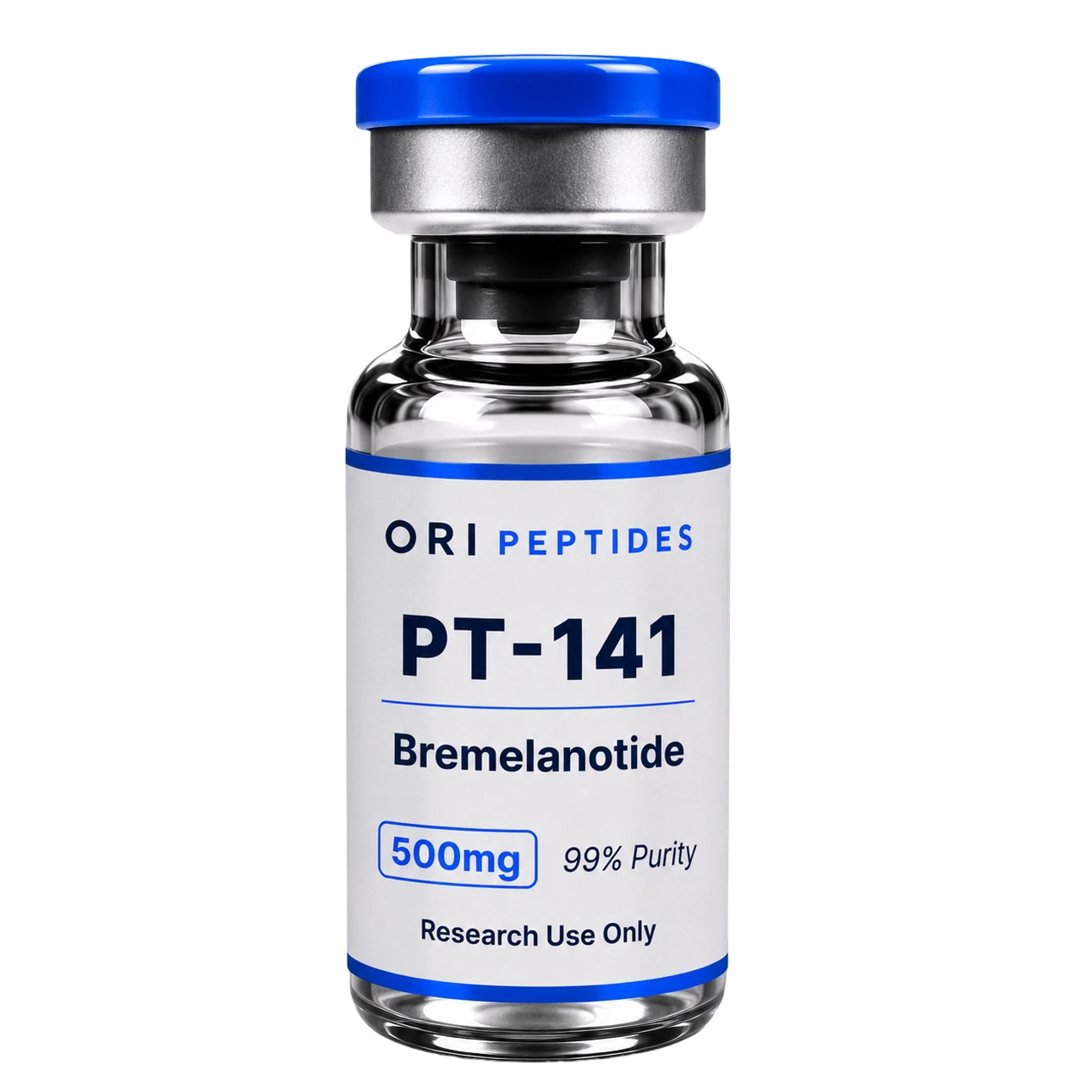
No. PT-141, also called bremelanotide, is a related compound. A 2020 review reports it is approved for one specific condition, and it is a separate molecule. The kisspeptin research guide covers another compound studied in sexual health research.
Key Takeaways
- Melanotan 2 is a man-made copy of alpha-MSH that switches on several melanocortin receptors.
- It was studied for tanning and erectile dysfunction in the 1990s and never became an approved medicine.
- Small early trials reported erections and nausea. A related compound, bremelanotide, later reached approval for low sexual desire.
- Case reports describe changed moles, melanoma, kidney and muscle injury, and priapism. Proof of cause is lacking for some of these, but health agencies still warn against it.
- Products sold online are unchecked, and no safe amount can be taken from this research.
Research Use Disclaimer
This content is provided for Research Use Only (RUO). The compounds discussed are not drugs, dietary supplements, foods, or cosmetics, and are not intended for human or animal consumption, diagnostic use, or therapeutic use of any kind. They have not been evaluated by the FDA for safety or efficacy in humans. Any research use must be conducted by qualified professionals in a controlled laboratory environment, in accordance with all applicable institutional, local, and federal regulations.
Sources
- Wikipedia contributors. Melanotan II. Wikipedia, The Free Encyclopedia.
- University of New South Wales. What is melanotan II, the drug that the TGA urges consumers to avoid. UNSW Newsroom. 2023.
- Hadley ME, Dorr RT. Melanocortin peptide therapeutics: historical milestones, clinical studies and commercialization. Peptides. 2006.
- Nasti TH, Timares L. MC1R, eumelanin and pheomelanin: their role in determining the susceptibility to skin cancer. Photochem Photobiol. 2015.
- Swope VB, Abdel-Malek ZA. MC1R: front and center in the bright side of dark eumelanin and DNA repair. Int J Mol Sci. 2018.
- Kim ES, Garnock-Jones KP. Afamelanotide: a review in erythropoietic protoporphyria. Am J Clin Dermatol. 2016.
- Wessells H, et al. Synthetic melanotropic peptide initiates erections in men with psychogenic erectile dysfunction: double-blind, placebo controlled crossover study. J Urol. 1998.
- Wessells H, et al. Melanocortin receptor agonists, penile erection, and sexual motivation: human studies with Melanotan II. Int J Impot Res. 2000.
- Ückert S, et al. Melanocortin receptor agonists in the treatment of male and female sexual dysfunctions: results from basic research and clinical studies. Expert Opin Investig Drugs. 2014.
- Mayer D, Lynch SE. Bremelanotide: new drug approved for treating hypoactive sexual desire disorder. Ann Pharmacother. 2020.
- Habbema L, et al. Risks of unregulated use of alpha-melanocyte-stimulating hormone analogues: a review. Int J Dermatol. 2017.
- Cardones AR, Grichnik JM. Alpha-melanocyte-stimulating hormone-induced eruptive nevi. Arch Dermatol. 2009.
- Reid C, et al. Atypical melanocytic naevi following melanotan injection. Ir Med J. 2013.
- Yassin Alsabbagh A, et al. Melanotan II nasal spray, a possible risk factor for oral mucosal malignant melanoma? Int J Oral Maxillofac Surg. 2025.
- Nelson ME, Bryant SM, Aks SE. Melanotan II injection resulting in systemic toxicity and rhabdomyolysis. Clin Toxicol. 2012.
- Peters B, et al. Melanotan II, a possible cause of renal infarction, review of the literature and case report. CEN Case Rep. 2020.
- Dreyer BA, Amer T, Fraser M. Melanotan-induced priapism, a hard-earned tan. BMJ Case Rep. 2019.
- Mallory CW, Lopategui DM, Cordon BH. Melanotan tanning injection, a rare cause of priapism. Sex Med. 2021.
- Gilhooley E, Daly S, McKenna D. Melanotan II user experience, a qualitative study of online discussion forums. Dermatology. 2021.
Explore the sexual wellness research category for related compounds, or view the PT-141 research material.