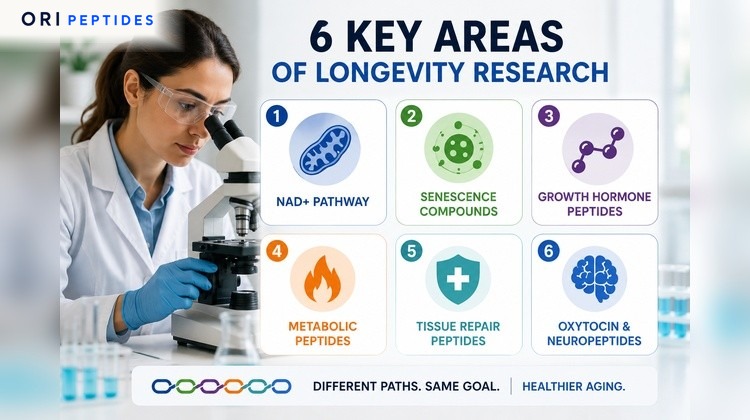
Aging research used to be a niche academic corner. That’s no longer true. Over the past several years, longevity science has pulled in attention from metabolic researchers, cell biologists, and pharmaceutical pipelines that historically had nothing to do with aging as a field. The result is a research landscape with far more active compound categories than most people realize, and a few that are getting disproportionate attention right now. This content is provided for Research Use Only (RUO).
Longevity Research Has a Crowded Pipeline
This is a landscape overview: what categories of compounds are drawing the most active research interest, and why, from a mechanism standpoint. It is not a guide to using any of them.
Category 1: NAD+ Pathway Compounds
Nicotinamide adenine dinucleotide (NAD+) is a coenzyme involved in core cellular energy metabolism, and its decline with age has made NAD+ pathway research one of the most active corners of longevity science. Research interest here centers on NAD+ itself and on its precursor molecules, including NMN (nicotinamide mononucleotide) and NR (nicotinamide riboside), studied for their role in replenishing NAD+ levels in cellular and animal models and their downstream effects on mitochondrial function.
Why it’s getting attention: NAD+ decline is one of the more consistently replicated findings across aging research models, which makes it an attractive target for mechanistic study.
Category 2: Senescence-Related Compounds
“Cellular senescence,” the state of cells that stop dividing but don’t die and instead accumulate with age, has become a major research theme. Compounds studied in this space, such as fisetin and quercetin, are typically investigated for their interaction with senescent cell pathways in preclinical models, an area often referred to in the literature as “senolytic” research.
Why it’s getting attention: Senescent cell accumulation has been linked in animal studies to multiple age-associated changes, making it one of the more mechanistically specific angles in the field.
Category 3: Growth Hormone Pathway Peptides
A well-established category, peptides that prompt the body’s own growth hormone release have been studied for decades. This category includes ghrelin-receptor agonists such as ipamorelin and growth hormone-releasing hormone (GHRH) analogs such as tesamorelin, which is also approved as a prescription drug for a specific condition. It has seen renewed research interest as newer analogs are developed with more selective receptor activity than earlier-generation compounds.
Why it’s getting attention: It’s one of the longest-studied peptide categories in this space, giving researchers a larger existing body of comparative literature to build on.
See also: Ipamorelin Benefits, What the Research Examines
Category 4: Multi-Pathway Metabolic Peptides
This is where longevity research increasingly overlaps with metabolic peptide research more broadly. Compounds originally developed for metabolic conditions, including multi-receptor agonist peptides, are now being studied for relevance to aging-associated metabolic decline, given the overlap between metabolic dysregulation and aging biomarkers in research models.
Why it’s getting attention: This is a genuinely new crossover. A category built for one research purpose is being independently investigated for its relevance to a different one, which suggests its mechanisms may reach further than first expected.
See also: The Next Chapter Beyond Weight Loss Drugs
Category 5: Peptide-Based Tissue Repair Compounds
A newer and more mechanistically diverse category, tissue-repair-associated peptides are being studied for their role in cellular repair signaling pathways, an area of growing interest as researchers look beyond metabolic and senescence pathways toward regenerative mechanisms.
Why it’s getting attention: It’s the least mature category on this list, which is exactly why it’s drawing fresh research interest. There’s more open territory here than in longer-studied categories.
Category 6: Oxytocin and Neuropeptide Signaling
Oxytocin, long studied primarily for its role in social and behavioral signaling, has more recently drawn interest from a different angle. Animal research has linked it to muscle maintenance and regeneration with age, and emerging studies are looking at its interaction with metabolic pathways. That makes it something of an outlier on this list: a neuropeptide being investigated for mechanisms well outside its original research context.
Why it’s getting attention: It represents an unusually direct crossover between behavioral neuroscience and metabolic aging research, two fields that historically had little overlap, which is part of what makes the early-stage data on it interesting to a broader set of researchers.
The Pattern Across All Six
None of these categories exist in isolation anymore. The more interesting trend is how much cross-pollination is happening: metabolic peptide research informing senescence research, growth hormone pathway data informing tissue-repair models, neuropeptide research like oxytocin bleeding into metabolic pathway study, and so on. Longevity science stopped being one narrow field with one target and became a landscape where multiple mechanism categories are actively borrowing from each other’s data.
FAQ
Why is NAD+ so central to longevity research?
NAD+ is a coenzyme involved in cellular energy metabolism, and its levels decline with age across many research models, which makes it a consistent and well-studied target.
What does “senolytic” mean?
It refers to research on compounds studied for their effect on senescent cells, cells that have stopped dividing but linger and accumulate with age. Most of this work is still preclinical.
Are any of these compounds approved as anti-aging treatments?
No. None of the compounds discussed here is approved to treat or slow aging. Research-grade material is intended for laboratory research only.
Research Use Disclaimer
This content is provided for Research Use Only (RUO). The compounds discussed are not drugs, dietary supplements, foods, or cosmetics, and are not intended for human or animal consumption, diagnostic use, or therapeutic use of any kind. They have not been evaluated by the FDA for safety or efficacy in humans. Any research use must be conducted by qualified professionals in a controlled laboratory environment, in accordance with all applicable institutional, local, and federal regulations.
Sources
- Verdin E. NAD+ in aging, metabolism, and neurodegeneration. Science. 2015;350(6265):1208-1213.
- Kirkland JL, Tchkonia T. Cellular senescence: a translational perspective. EBioMedicine. 2017;21:21-28.
- Elabd C, et al. Oxytocin is an age-specific circulating hormone that is necessary for muscle maintenance and regeneration. Nature Communications. 2014;5:4082.