
Two studies from Imperial College London have brought renewed attention to kisspeptin. Both were published in JAMA Network Open and tested kisspeptin in women and men with hypoactive sexual desire disorder (HSDD), which means low sexual desire that causes personal distress. According to the research team’s news release, HSDD affects up to 10 percent of women and 8 percent of men worldwide. The team said the results suggest kisspeptin deserves more study in this area. The work was funded by the UK’s Medical Research Council and the National Institute for Health Research. The same group had earlier reported that kisspeptin changed how the brain responds to sexual cues in men with normal desire, and that this did not depend on other reproductive hormones such as testosterone.
Kisspeptin is a tiny protein made in the brain. It works like a switch that starts puberty and helps the body make sex hormones. This guide covers what kisspeptin is, what it does, what studies in people have found, and how it compares with other hormone-related compounds. It reports research only and is not advice for any person.
What Is Kisspeptin?
Kisspeptin is a small protein. Proteins are chains of building blocks called amino acids. Kisspeptin comes from a gene called KISS1. The body first makes a long chain of 145 building blocks, then cuts it into shorter pieces. The longest piece is kisspeptin-54, first called metastin. The shorter pieces are kisspeptin-14, kisspeptin-13, and kisspeptin-10. The number tells you how many building blocks are in the piece.
All of the pieces share the same end section. That shared end lets them fit the same “lock” on cells, called a receptor. This receptor is named GPR54, or KISS1R.
The story began in 1996 in Hershey, Pennsylvania. A research group there was looking for genes that stop melanoma, a skin cancer, from spreading. The receptor was found in 1999. In 2003, research teams reported that people with faulty copies of the receptor did not go through puberty. That moved kisspeptin out of cancer research and into hormone research.
| Form | Size | What to know |
|---|---|---|
| Kisspeptin-54 | 54 building blocks | The longest form. It was used in the IVF and sex drive studies described below. |
| Kisspeptin-14 and kisspeptin-13 | 14 and 13 building blocks | Shorter pieces that share the same end section. |
| Kisspeptin-10 | 10 building blocks | A 2011 study called it the smallest piece that still works fully. It is common in lab work. |
What Does Kisspeptin Do in the Body?
The body’s reproductive system works like a chain of messages. The brain sends a message to a small gland called the pituitary. The pituitary then sends messages to the ovaries and testes. Kisspeptin starts the whole chain.
- Kisspeptin starts the message. It fits onto the receptor on brain cells that make a hormone called GnRH. A 2005 study showed that kisspeptin makes these cells release GnRH directly.
- GnRH tells the pituitary to act. The pituitary then releases two more hormones, called LH and FSH.
- LH and FSH tell the ovaries and testes to act. These two hormones travel through the blood. The ovaries and testes then make sex hormones, such as estrogen and testosterone, and help eggs and sperm develop.
A 2014 review in the journal Human Reproduction Update calls kisspeptin the main controller of this chain. It says kisspeptin is needed for puberty to start, for the body to adjust its hormone levels, and for fertility in adults. It works with two other signals, neurokinin B and dynorphin, which help GnRH come out in short bursts.
Kisspeptin also connects the reproductive system to the body’s energy supply. Reference sources say a hormone from body fat, called leptin, affects kisspeptin cells. This is one explanation for why low body fat can stop periods in some athletes. A 2014 review in the journal Reproduction says kisspeptin may help link energy levels to fertility.
Researchers also found kisspeptin outside the brain. A 2015 review called “Kisspeptin, beyond the brain” describes it in the ovary, placenta, pancreas, and kidney. It has been linked to a fertilized egg attaching to the womb, insulin release, and blood vessel growth. These are early findings. They show where kisspeptin is found, not what it does for any person. For a wider look at hormone research and women’s health, see the women’s longevity and peptides article.
See also: CJC-1295 and Ipamorelin in Research Studies Explained
How Is Kisspeptin Linked to Sex Drive and Sexual Health?
Sexual desire does not come from one switch. It depends on hormones, the brain, mood, stress, general health, and relationships. Kisspeptin is of interest for two reasons. First, it sits at the start of the hormone chain that makes the sex hormones. These hormones drive sexual development in puberty, and in adults they help shape sexual interest and keep the reproductive organs working. Second, kisspeptin is also found in parts of the brain linked to emotion and sexual response, according to a 2018 review in the Journal of Endocrinology.
A 2018 brain-scan study in healthy men looked at this second link. The men received kisspeptin on one day and a dummy treatment, called a placebo, on another. Kisspeptin changed how different brain areas worked together. Those changes were linked to stronger brain responses to sexual images and to lower scores on a questionnaire about sexual aversion, which means a dislike of or wish to avoid sex.
Two later studies looked at people with low sexual desire. In this setting, the medical term is hypoactive sexual desire disorder, which means low desire that causes personal distress. The 2022 trial in women and the 2023 trial in men gave kisspeptin through a vein for a short time and compared it with a placebo. Both reported changes in brain activity linked to sexual and attraction cues. In the men’s trial, the researchers also measured physical arousal and self-reported feelings during the session, and they reported changes in some of those measures compared with placebo.
These studies were small, and each person took part in only a short session. They do not show that kisspeptin treats low desire. Low desire has many possible causes, including hormones, stress, health problems, medicines, and relationship issues. Anyone with concerns about sexual health should speak with a qualified health professional.
Is Kisspeptin Being Studied as a Treatment?
Yes, but only in early research. Reviews describe kisspeptin as a compound being tested for several fertility-related problems. None of the sources cited here calls it a proven therapy. The main areas of study are below.
- Helping eggs mature in IVF. In IVF, a “trigger” injection finishes maturing the eggs before they are collected. The most common trigger, called hCG, raises the risk of ovarian hyperstimulation syndrome (OHSS), a serious swelling of the ovaries. A different trigger, a GnRH agonist, is used as a safer option. Trials tested kisspeptin-54 as another kind of trigger.
- Missing periods caused by stress or low body weight. In this condition, the brain’s GnRH messages slow down. Trials tested whether kisspeptin could restart them.
- Low sexual desire and brain responses. Two trials, one in women and one in men, looked at how kisspeptin changes the brain’s response to sexual and attraction cues.
- Hormone levels in men. Small studies gave kisspeptin-10 to healthy men and to men with type 2 diabetes to see how LH and testosterone changed.
These are all research questions. None has led to a standard dose or an accepted use.
What Does the Research Actually Show?
The studies are small and short, so their findings need to be read in that context.
IVF trials. A 2015 early-stage trial gave 60 women at high risk of OHSS a single injection of kisspeptin-54 as the trigger. Eggs matured in nearly all of the women, and none developed moderate or severe OHSS. Everyone knew they were getting kisspeptin, and there was no comparison group. A 2017 trial in 62 women found that a second injection helped more women reach a good egg count. A 2017 review called kisspeptin a promising trigger but said more studies are needed. The same research team reported that one injection causes a rise in LH that lasts about 12 to 14 hours.
Missing periods. A 2009 study in women with stress-related missing periods found that one injection of kisspeptin-54 strongly raised LH and FSH. But when it was given again and again over time, the body responded less and less.
Kisspeptin-10 in men. A 2011 study gave kisspeptin-10 through a vein to healthy men. LH went up as the amount increased, but the response was smaller at the highest amount tested. A 22.5-hour infusion raised LH and testosterone and made LH come in bursts more often. A 2013 study of five men with type 2 diabetes and low testosterone also saw LH rise after kisspeptin-10.
Sex drive and brain responses. A 2022 trial enrolled 40 women with low sexual desire, and 32 finished. Each woman had two sessions, one with a 75-minute kisspeptin-54 infusion and one with a placebo. Brain scans showed changes in how the brain handled sexual and attraction cues. The researchers said the infusion was well tolerated, with no side effects reported. A 2023 trial in 37 men, of whom 32 finished, reported changes in brain activity compared with placebo.
These results are hormone and brain measurements taken during short sessions. They do not show that kisspeptin treats any condition.
Kisspeptin vs. Other Hormone Therapies
The comparison is clearest when looking at where each one acts in the message chain.
| Compound | Where it acts | What researchers note |
|---|---|---|
| Kisspeptin | The brain, on GnRH cells | Works through the body’s own GnRH messages instead of replacing a hormone further down the chain. |
| GnRH agonists and antagonists | The pituitary gland | Used in IVF treatment plans. A GnRH agonist is also used as an egg trigger. |
| hCG | The ovary | The most common egg trigger, but linked to a higher risk of OHSS. |
| FSH | The ovary | Given in IVF to help egg sacs grow before the trigger. |
The main difference is where each one starts. Kisspeptin acts at the top of the chain, so it asks the brain to release its own GnRH. The others work further down. That is one reason researchers are interested in kisspeptin as a possible egg trigger.
Growth hormone peptides use a different pathway altogether. For a look at that area, the ipamorelin benefits guide and the tesamorelin guide show how researchers study growth hormone signals.
See also: MK-677 Benefits, What Current Research Shows
What Are the Potential Side Effects?
Safety information in people comes from small, short studies, so the full picture is unknown. The research record notes the following.
- No side effects in the sex drive trial. The 2022 trial in women described the single infusion as well tolerated, with no side effects reported.
- Rare OHSS in the IVF trials. In the 2015 trial, no woman developed moderate or severe OHSS. In the 2017 trial, one woman in the single-dose group had moderate OHSS, and none did in the two-dose group.
- Changes in cycle timing. In a 2013 study of healthy women, a week of twice-daily kisspeptin-54 injections did not stop their periods. But the second half of the cycle started earlier than usual.
- A weaker response over time. In women with missing periods, repeated doses led to a smaller response each time. This matters for how researchers plan studies.
- Unknown long-term effects. The studies were short, and nobody followed the people for years. Reviews say long-term safety has not been established.
This is a summary of research reports. It is not a list of effects anyone should expect.
Who Might Benefit From Kisspeptin-Related Therapies in the Future
No one has been shown to benefit from kisspeptin. The groups below are the ones researchers are studying, based on what the biology suggests.
- People whose puberty does not start. Faulty copies of the receptor are linked to missing puberty, so this group is central to the basic science.
- Women with stress-related or weight-related missing periods. Reviews describe slowed GnRH messages in this condition, which is the message kisspeptin controls.
- IVF patients at high risk of OHSS. This is the most developed area of research so far, and reviews still ask for more studies.
- Men with low testosterone linked to diabetes. Only one small study has looked at this.
- People with low sexual desire. This research is at the earliest stage and relies on brain scans.
All of this is early, and it may not lead to anything. Larger and longer studies, with comparison groups, would be needed before any of these could be called a treatment.
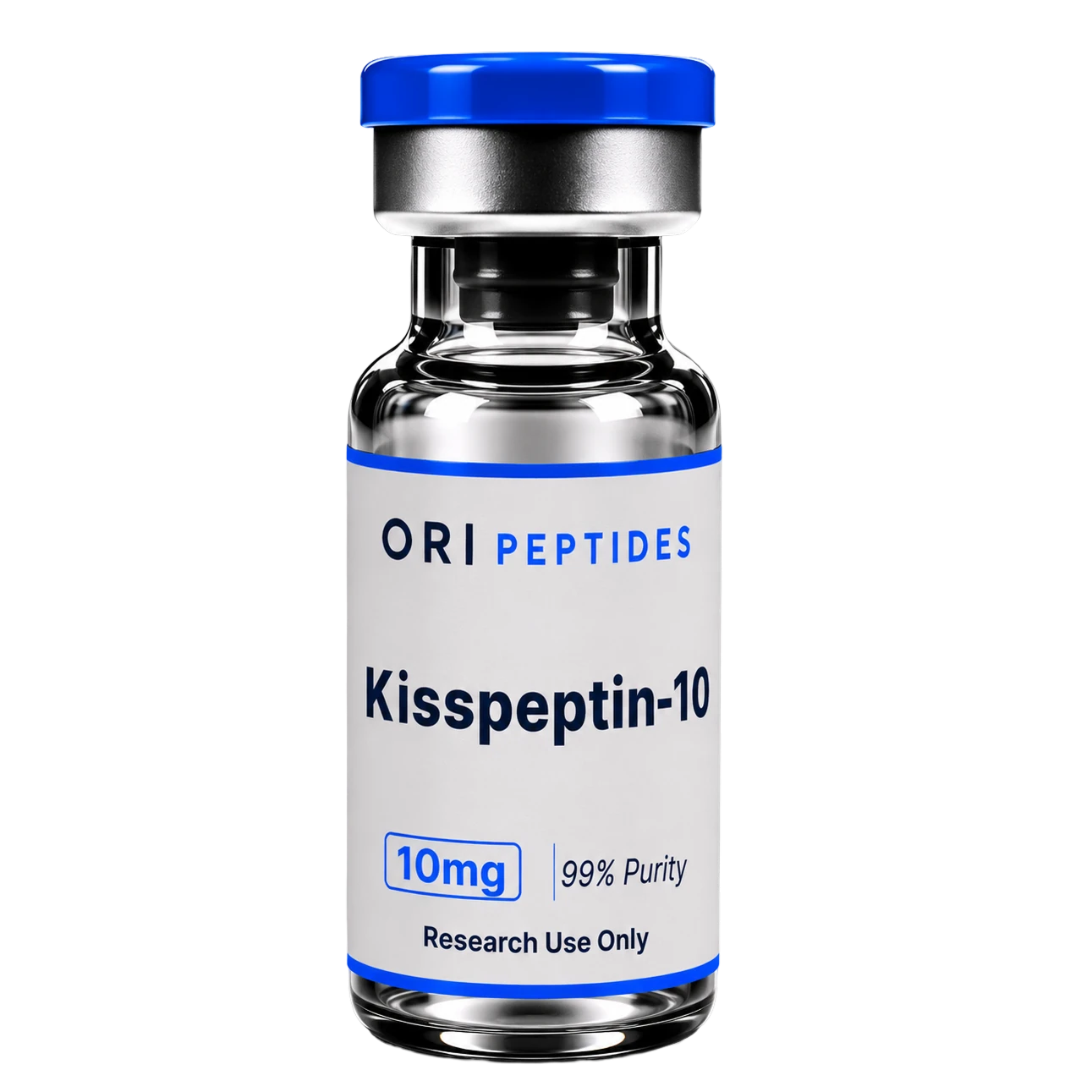
HORMONE THERAPY
Kisspeptin-10
Frequently Asked Questions
Is kisspeptin an approved medicine?
Reviews describe kisspeptin as an experimental compound, and the trials so far are early. The research kisspeptin sold here is for laboratory use only and is not meant for people.
Does kisspeptin affect sex drive?
Researchers are studying this question. Brain-scan studies found that kisspeptin changed how the brain responds to sexual cues. But these were small, short studies, and they do not show that kisspeptin changes sex drive in daily life.
What is the difference between kisspeptin-54 and kisspeptin-10?
They are two sizes of the same signal. Kisspeptin-54 is the longest form, and kisspeptin-10 is the shortest piece that still fits the receptor. The IVF and sex drive trials above used kisspeptin-54, and the earlier studies in men used kisspeptin-10.
Does kisspeptin raise testosterone?
In small, supervised studies in men, kisspeptin-10 raised LH, and a long infusion also raised testosterone. These were measurements taken over a few hours. They do not show that kisspeptin is a way to raise testosterone over time.
How is research kisspeptin-10 stored in the lab?
It usually arrives as a freeze-dried powder with a Certificate of Analysis (COA). The product page says to store the dry powder at minus 20 degrees Celsius, and to keep it in a refrigerator at 2 to 8 degrees Celsius after it is mixed with liquid. Researchers typically use bacteriostatic water as the diluent. The peptide reconstitution guide and the Concentration Calculator explain the lab steps. There is no approved or standard dose, and this guide does not suggest one.
See also: Peptide Reconstitution Ratios & How to Calculate Them
Key Takeaway
Kisspeptin is a brain signal that starts the chain leading to puberty, fertility, and the sex hormones. Early studies in people have looked at it for IVF, missing periods, hormone levels, and sexual response in the brain. Short trials reported few side effects. The studies are small and the long-term picture is unknown, so kisspeptin remains a research compound.
Research Use Disclaimer
This content is provided for Research Use Only (RUO). The compounds discussed are not drugs, dietary supplements, foods, or cosmetics, and are not intended for human or animal consumption, diagnostic use, or therapeutic use of any kind. They have not been evaluated by the FDA for safety or efficacy in humans. Any research use must be conducted by qualified professionals in a controlled laboratory environment, in accordance with all applicable institutional, local, and federal regulations.
Sources
- Messager S, et al. Kisspeptin directly stimulates gonadotropin-releasing hormone release via G protein-coupled receptor 54. Proc Natl Acad Sci U S A. 2005.
- Skorupskaite K, George JT, Anderson RA. The kisspeptin-GnRH pathway in human reproductive health and disease. Hum Reprod Update. 2014.
- De Bond JA, Smith JT. Kisspeptin and energy balance in reproduction. Reproduction. 2014.
- Bhattacharya M, Babwah AV. Kisspeptin, beyond the brain. Endocrinology. 2015.
- Mills EGA, Dhillo WS, Comninos AN. Kisspeptin and the control of emotions, mood and reproductive behaviour. J Endocrinol. 2018.
- Comninos AN, et al. Modulations of human resting brain connectivity by kisspeptin enhance sexual and emotional functions. JCI Insight. 2018.
- Abbara A, et al. Efficacy of kisspeptin-54 to trigger oocyte maturation in women at high risk of ovarian hyperstimulation syndrome during in vitro fertilization therapy. J Clin Endocrinol Metab. 2015.
- Abbara A, et al. A second dose of kisspeptin-54 improves oocyte maturation in women at high risk of ovarian hyperstimulation syndrome, a phase 2 randomized controlled trial. Hum Reprod. 2017.
- Kasum M, et al. Kisspeptin as a promising oocyte maturation trigger for in vitro fertilisation in humans. Gynecol Endocrinol. 2017.
- Jayasena CN, et al. Subcutaneous injection of kisspeptin-54 acutely stimulates gonadotropin secretion in women with hypothalamic amenorrhea, but chronic administration causes tachyphylaxis. J Clin Endocrinol Metab. 2009.
- Jayasena CN, et al. Twice-daily subcutaneous injection of kisspeptin-54 does not abolish menstrual cyclicity in healthy female volunteers. J Clin Endocrinol Metab. 2013.
- George JT, et al. Kisspeptin-10 is a potent stimulator of LH and increases pulse frequency in men. J Clin Endocrinol Metab. 2011.
- George JT, et al. Exploring the pathophysiology of hypogonadism in men with type 2 diabetes, kisspeptin-10 stimulates serum testosterone and LH secretion in men with type 2 diabetes and mild biochemical hypogonadism. Clin Endocrinol. 2013.
- Thurston L, et al. Effects of kisspeptin administration in women with hypoactive sexual desire disorder, a randomized clinical trial. JAMA Netw Open. 2022.
- Mills EG, et al. Effects of kisspeptin administration in men with hypoactive sexual desire disorder, a randomized clinical trial. JAMA Netw Open. 2023.
- Battipaglia C, et al. Low-dose estrogens as neuroendocrine modulators in functional hypothalamic amenorrhea. Biomedicines. 2023.
- Imperial College Healthcare NHS Trust. News release on kisspeptin and low sexual desire studies. imperial.nhs.uk.
- Wikipedia. Kisspeptin. en.wikipedia.org/wiki/Kisspeptin.
Explore the hormone therapy research category for related compounds, view the Kisspeptin-10 research material, or browse the sexual wellness category and the full shop.