
The SS-31 peptide is a tiny lab-made molecule that researchers use to study mitochondria, the small power plants inside your cells. It is also known as elamipretide, and it is one of the few mitochondria-targeted compounds that has been tested in human clinical trials. This guide explains what SS-31 is, how it works, what the trials and lab studies report, and how it differs from MOTS-C. It describes research only and is not advice for any person.
What Is SS-31 Peptide?
SS-31 is a tetrapeptide, which means a chain of just four amino acids. Amino acids are the building blocks of proteins. A 2025 review in the International Journal of Molecular Sciences lists its other names as elamipretide, MTP-131, and Bendavia. All of these names refer to the same molecule.
Mitochondria turn food into the energy your cells run on. When they stop working well, cells run short of energy. This is called mitochondrial dysfunction, and researchers link it to many conditions, including heart, nerve, and muscle disorders. SS-31 was designed as a tool to study and protect mitochondria.
One point matters for anyone reading about this compound. In September 2025, the US FDA granted accelerated approval to a medicine made from elamipretide, sold as Forzinity, for muscle strength in people with Barth syndrome. This is according to a 2026 article in the journal Drugs. Barth syndrome is an ultra-rare inherited disorder. That medicine is made and prescribed under strict rules for one specific condition. Research-grade SS-31 sold for laboratory use is a different product, and nothing in this guide is a claim about it for any person.
What Makes SS-31 Different?
Most compounds that touch mitochondria spread through the whole cell. SS-31 is different. The 2025 review says it has a structure that lets it enter many kinds of cells and then go selectively to the mitochondria. A 2025 review in Biomedicine and Pharmacotherapy calls it a potential first-in-class compound that targets the inner mitochondrial membrane.
It is also unusual because of how far its research has gone. Many compounds in this field are only studied in dishes and lab models. SS-31 has gone through trials in people with Barth syndrome, mitochondrial muscle disease, a form of age-related eye disease, and heart failure. That does not mean it works for all of those conditions. As the sections below show, some trials did not meet their main goals.
See also: Glutathione Peptide and What Antioxidant Research Shows
How SS-31 Peptide Works Through Cardiolipin
Picture the inside of a mitochondrion as a building full of folded walls. The folds are called cristae, and the energy machinery sits on them. The more folded and stable the walls, the better the building makes energy. A fatty molecule called cardiolipin acts like scaffolding that holds those folds in shape.
A 2013 paper in the Journal of the American Society of Nephrology showed that SS-31 binds to cardiolipin with high affinity. In a lab model of blood flow loss, SS-31 protected the folded walls, helped cells regain energy faster after the blood returned, and reduced injury. The same paper found that the SS-31 and cardiolipin pair blocks a process that damages cardiolipin during stress.
Early ideas said SS-31 worked mainly by mopping up harmful oxygen byproducts. The 2025 Biomedicine and Pharmacotherapy review says the last ten years of work have gone well beyond that. Different research teams have confirmed the cardiolipin link. Newer studies describe changes in the electrical charge of the mitochondrial membrane and in how cardiolipin-dependent proteins come together. These effects are linked to better mitochondrial structure and energy output in lab work.
How SS-31 Complements MOTS-C in Mitochondrial Function
SS-31 and MOTS-C are both studied for mitochondria, but they are different molecules that work in different places. The MOTS-c research guide covers MOTS-C in detail. The table shows the main differences.
| Feature | SS-31 | MOTS-C |
|---|---|---|
| Where it comes from | Made in the lab | Made by mitochondrial DNA in the body |
| Size | 4 amino acids | 16 amino acids |
| Where it acts | Inner mitochondrial membrane, binds cardiolipin | Moves to the nucleus under stress and shifts gene activity |
| Main research focus | Mitochondrial structure and energy output | Glucose and muscle metabolism |
| Human clinical program | Several trials, one approval for Barth syndrome | A 2023 review says no clinical method has been developed |
The word “complements” describes how these two fit on a map of mitochondrial biology, not a tested combination. SS-31 acts on the structure inside the power plant. MOTS-C acts more like a signal sent from the power plant to the rest of the cell. No study cited here tested them together, and no one can say whether using both would add up to more.
See also: MK-677 Benefits, What Current Research Shows
What Research Shows About SS-31’s Potential Benefits
The findings below come from clinical trials in specific medical conditions and from lab studies. They are not proof of a benefit for healthy people.
- Barth syndrome. In a long-term extension of the TAZPOWER trial, 8 of 10 patients reached week 168. The 2024 paper in Genetics in Medicine reports that elamipretide was well tolerated, with injection-site reactions the most common side effect. Walking distance and fatigue scores improved, and heart measurements moved in a good direction. This was a small, open-label study, which means there was no placebo group during that phase.
- Mitochondrial muscle disease. The MMPOWER-3 trial enrolled 218 adults. A 2023 paper in Neurology reports that it did not meet its main goals for walking distance or fatigue.
- Dry age-related eye disease. A 2025 paper reports that the ReCLAIM-2 trial of 176 patients did not meet its main goals for vision or the size of the damaged area. It did report a slower loss of a structural layer in the retina. Side effects were reported in 86 percent of the treated group and 71 percent of the placebo group, most often at the injection site.
- Heart failure. A 2017 paper in Circulation: Heart Failure studied 36 patients, 24 of whom received a single infusion of elamipretide. It was safe and well tolerated, and the highest dose group showed lower heart chamber volumes. The authors said longer studies were needed.
- Lab studies. The 2025 review summarizes lab findings in models of heart failure, nerve damage, blood flow injury, metabolic disease, and muscle weakness.
The picture is mixed. There is one approval for a rare disease, some encouraging signs, and several trials that missed their targets. No dose can be taken from this research for anyone outside a trial, and this guide does not give one.
Why SS-31 Appears in Longevity Research
Aging researchers have long pointed to mitochondria. The 2025 Biomedicine and Pharmacotherapy review says mitochondrial dysfunction is central to the aging process and to a wide range of diseases. A compound that is built to protect the mitochondrial membrane, and that has human trial data behind it, naturally draws attention.
There are limits to that story. The human trials above studied people with specific diseases, not healthy aging. No trial cited here tested SS-31 as a way to slow aging, and online claims that it reverses aging are not supported by that record. Researchers who study this topic also look at related areas, including NAD+ and mitochondrial energy, as another way to ask how cells keep their energy supply steady.
See also: GHK-Cu Benefits, What Current Research Examines
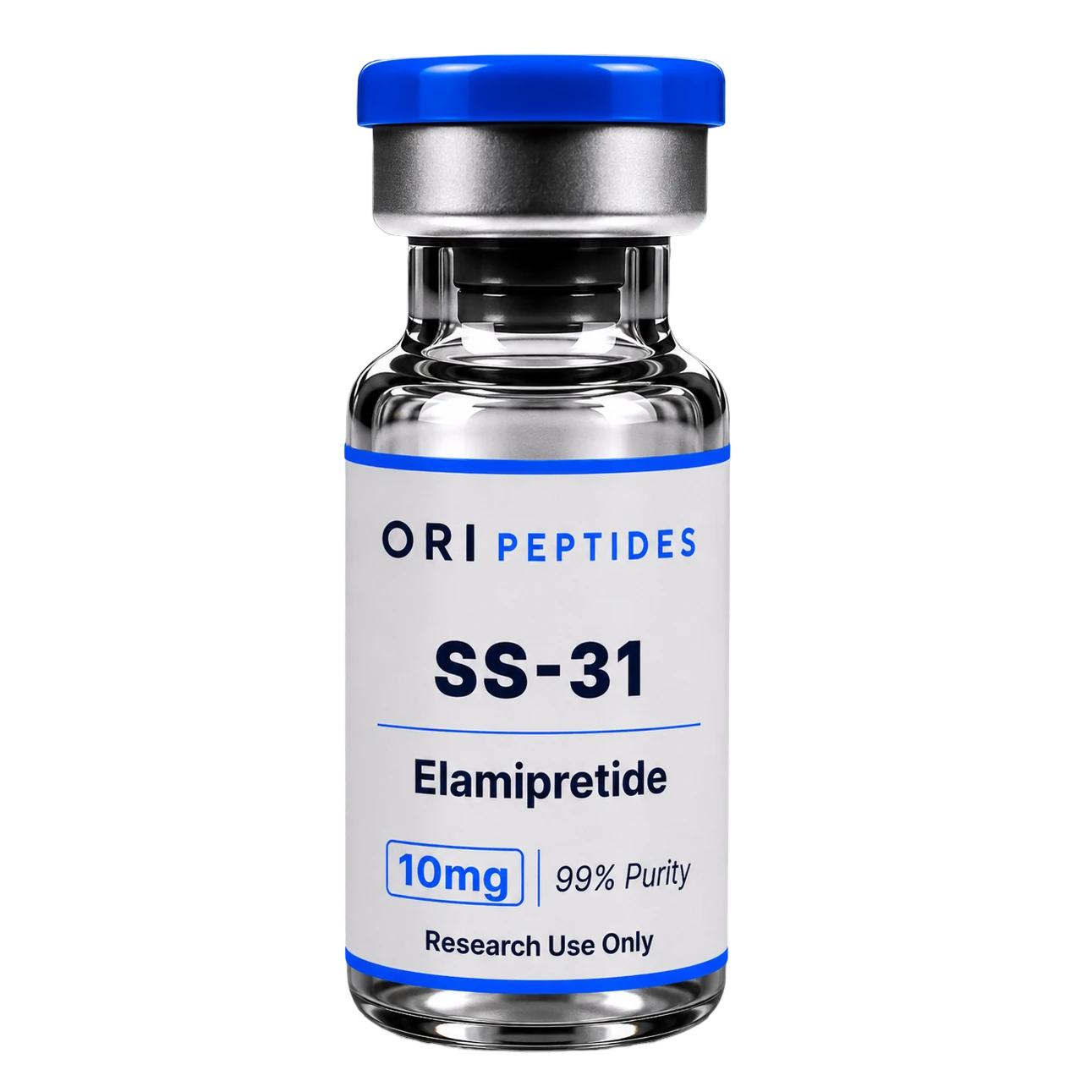
ANTI-AGING
SS-31
Frequently Asked Questions
Is SS-31 the same as elamipretide?
Yes. SS-31, elamipretide, MTP-131, and Bendavia are names for the same four amino acid molecule.
Is SS-31 approved by the FDA?
A medicine based on elamipretide received accelerated approval in September 2025 for muscle strength in a group of people with Barth syndrome. That approval covers a specific product made for a specific condition. It does not cover research-grade SS-31 or any other use.
Has SS-31 been tested in people?
Yes. It has been tested in trials of Barth syndrome, mitochondrial muscle disease, dry age-related eye disease, and heart failure. Results are mixed, and some trials missed their main goals.
What side effects were reported in trials?
The most common reports were injection-site reactions, such as itching, pain, and bruising. Some trials also reported other adverse events. These came from supervised trials in people with specific conditions.
Does SS-31 do the same thing as MOTS-C?
No. SS-31 is a lab-made molecule that binds cardiolipin in the mitochondrial membrane. MOTS-C is made by mitochondrial DNA and acts as a signal that reaches the cell nucleus.
Key Takeaways
- SS-31 is a four amino acid peptide, also called elamipretide, studied for how it targets mitochondria.
- It binds cardiolipin, a fatty molecule that helps hold the folded walls of the mitochondrion in shape.
- A medicine based on elamipretide has accelerated FDA approval for Barth syndrome only. That does not extend to research-grade material or to other uses.
- Trials in other conditions have shown mixed results, and no trial has tested it as an anti-aging treatment.
- It is different from MOTS-C in origin, size, and where it acts.
Research Use Disclaimer
This content is provided for Research Use Only (RUO). The compounds discussed are not drugs, dietary supplements, foods, or cosmetics, and are not intended for human or animal consumption, diagnostic use, or therapeutic use of any kind. They have not been evaluated by the FDA for safety or efficacy in humans. Any research use must be conducted by qualified professionals in a controlled laboratory environment, in accordance with all applicable institutional, local, and federal regulations.
Sources
- Shirley M. Elamipretide: first approval. Drugs. 2026.
- Tung C, et al. Elamipretide: a review of its structure, mechanism of action, and therapeutic potential. Int J Mol Sci. 2025.
- Birk AV, et al. The mitochondrial-targeted compound SS-31 re-energizes ischemic mitochondria by interacting with cardiolipin. J Am Soc Nephrol. 2013.
- Sabbah HN, et al. Contemporary insights into elamipretide’s mitochondrial mechanism of action and therapeutic effects. Biomed Pharmacother. 2025.
- Thompson WR, et al. Long-term efficacy and safety of elamipretide in patients with Barth syndrome, 168-week open-label extension results of TAZPOWER. Genet Med. 2024.
- Karaa A, et al. Efficacy and safety of elamipretide in individuals with primary mitochondrial myopathy, the MMPOWER-3 randomized clinical trial. Neurology. 2023.
- Ehlers JP, et al. ReCLAIM-2, a randomized phase II clinical trial evaluating elamipretide in age-related macular degeneration, geographic atrophy growth, visual function, and ellipsoid zone preservation. Ophthalmol Sci. 2025.
- Daubert MA, et al. Novel mitochondria-targeting peptide in heart failure treatment, a randomized, placebo-controlled trial of elamipretide. Circ Heart Fail. 2017.
- Zheng Y, et al. MOTS-c, a promising mitochondrial-derived peptide for therapeutic exploitation. Front Endocrinol. 2023.
- Lee C, et al. MOTS-c, a novel mitochondrial-derived peptide regulating muscle and fat metabolism. Free Radic Biol Med. 2016.
Explore the anti-aging research category for related compounds, or view the SS-31 research material.