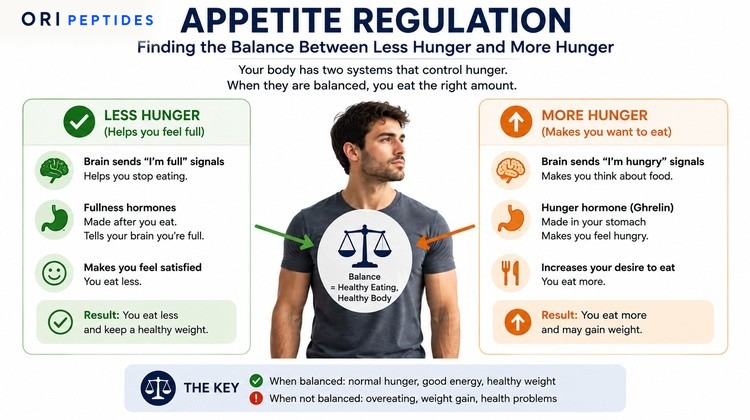
Appetite regulation research has moved away from the idea that hunger can be explained by a single dominant signal. Researchers now examine how GLP-1, GIP, and glucagon pathways overlap, including through retatrutide research and other multi-receptor models. This article looks at that shift from a Research Use Only perspective, focusing on metabolic signaling rather than guidance for human use.
A Problem That Looked Simple From the Outside
For a long time, appetite regulation research operated on a fairly simple working assumption: find the one signal that tells the brain “stop eating,” target it, and the rest would follow. It’s an intuitive starting point. Appetite feels like a single sensation, so it seemed reasonable to assume it might be governed by a single dominant pathway.
That assumption didn’t survive contact with the research. What’s turned out to be true is almost the opposite: appetite regulation involves multiple overlapping systems that all talk to each other, and no single pathway tells the whole story. Understanding why that complexity exists explains a lot about why the current generation of metabolic peptides looks the way it does.
The First Signal: GLP-1
GLP-1 was one of the earliest and most successful targets in this research space, and for good reason. It’s genuinely involved in insulin secretion and satiety signaling. Early single-target GLP-1 research produced real, measurable effects in research models, which reinforced the idea that appetite regulation might be a single-pathway problem after all.
But researchers studying GLP-1 in isolation kept running into the same limitation: the effects were real, but incomplete. Something else was clearly involved.
The Second Signal: GIP
GIP research added a second piece to the puzzle. Structurally related to GLP-1 but acting through a distinct receptor, GIP research revealed that glucose-dependent insulin signaling had its own separate pathway running in parallel with GLP-1’s, not a redundant backup system, but a genuinely separate mechanism with its own research profile.
This is the point where the “one signal” assumption started to break down in a scientifically interesting way. If two distinct receptor systems were both independently involved in metabolic regulation, appetite research was clearly not a single-pathway problem.
The Third Signal: Glucagon
The glucagon receptor pathway complicated the picture further. Glucagon belongs to the same broad hormone family as GLP-1 and GIP, but its receptor engages a noticeably different part of metabolic signaling, one more associated with energy expenditure research than appetite signaling directly. Its relevance to this research space wasn’t obvious until researchers began studying it in combination with the other two pathways.
That’s the real insight multi-agonist peptide research revealed: these systems don’t operate independently. They interact, and studying them separately had been giving researchers an incomplete picture the whole time.
See also: The Next Chapter Beyond Weight Loss Drugs
Why This Changes How Researchers Approach the Problem
The practical result of this complexity is that appetite and metabolic regulation research has shifted from a “find the one lever” model to a “map the interacting system” model. That’s a much harder research problem, but it’s also a more accurate one, and it’s the direct reason multi-receptor compounds like retatrutide are being developed and studied in clinical trials. Acting on three interacting pathways with a single stable molecule is a more tractable way to study a genuinely multi-system problem than trying to layer three separate single-target compounds together.
The Puzzle Is Better Mapped, Not Solved
None of this means researchers have found the full picture. If anything, each new pathway identified tends to raise new questions about how it interacts with the others. But the field has moved from assuming a simple answer to actively mapping a genuinely complex system, and that shift in approach is arguably a bigger research development than any single compound to come out of it.
FAQ
Why isn’t appetite controlled by a single hormone?
Research shows several overlapping signals, including GLP-1, GIP, and glucagon, each influence appetite, insulin, and energy balance in different ways, and they interact rather than working in isolation.
What does a “multi-receptor” compound mean?
It’s a single molecule designed to act on more than one hormone receptor. Tirzepatide acts on two (GLP-1 and GIP), while retatrutide, still investigational, acts on three (GLP-1, GIP, and glucagon).
Has appetite regulation been fully explained?
No. The field has a much better map of the interacting pathways, but each new finding tends to raise new questions about how the systems work together.
Research Use Disclaimer
This content is provided for Research Use Only (RUO). The compounds discussed are not drugs, dietary supplements, foods, or cosmetics, and are not intended for human or animal consumption, diagnostic use, or therapeutic use of any kind. They have not been evaluated by the FDA for safety or efficacy in humans. Any research use must be conducted by qualified professionals in a controlled laboratory environment, in accordance with all applicable institutional, local, and federal regulations.
Sources
- Holst JJ. The physiology of glucagon-like peptide 1. Physiological Reviews. 2007;87(4):1409-1439.
- Jastreboff AM, et al. Triple-Hormone-Receptor Agonist Retatrutide for Obesity: A Phase 2 Trial. New England Journal of Medicine. 2023;389(6):514-526.