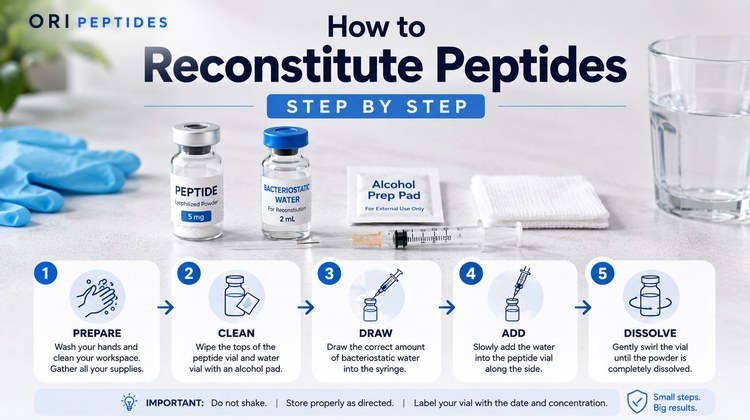
Reconstituting a peptide just means adding water to the dry powder in a vial to turn it into a liquid. Peptide reconstitution ratios are simply how much peptide is in the vial compared to how much water gets added. Get that ratio wrong, or forget to write it down, and every measurement taken from that vial afterward will be off by the same amount. This guide walks through the math in plain terms, with worked examples by vial size, and how to turn a mixed strength into an actual syringe draw. This content is provided for Research Use Only (RUO).
Why the Ratio Matters
The same peptide vial can end up at noticeably different strengths, depending only on how much water gets added. There is no single correct amount of water. It is a choice based on what a specific research protocol calls for.
That choice matters because everything measured afterward depends on getting it right. If the strength is not worked out, and written down, correctly, every measurement taken from that vial later will be off by the same amount, even if every other step was done carefully. Getting the ratio right, and labeling the vial the moment it is mixed, is what keeps every later measurement accurate and easy to double check.
See also: Step-by-Step Reconstitution Guide
The Variables That Drive It
- How much peptide is in the vial, measured in milligrams (mg). This number does not change. It is printed on the vial and confirmed by the certificate of analysis, the lab paperwork confirming what is actually inside and how pure it is.
- How much water gets added, measured in milliliters (mL). This is the one part that is actually controlled, and it is what sets the final strength, also called the concentration, meaning how much peptide ends up packed into each mL of liquid. Researchers typically use bacteriostatic water as the diluent.
- How precise the measurement needs to be. Measuring out a small amount is usually easier with a weaker mix, since more water spreads the same amount of peptide across a larger volume of liquid.
- How much the vial can hold. Every vial has a limit on how much liquid fits inside it, which caps how weak the mix can be made.
- What the measurement is being taken with. A regular syringe is marked in milliliters, but many researchers use insulin-style syringes marked in units instead, where 100 units equals 1 mL on a standard U-100 syringe. That changes how a strength gets turned into a mark on the syringe, covered further down.
Worked Examples by Vial Size
Micrograms (mcg) come up in these examples too. There are 1,000 micrograms in every milligram, so 2 mg is the same amount as 2,000 mcg, just written a different way.
- A 2 mg vial. Adding 1 mL of water gives 2 mg per mL, the same as 2,000 mcg per mL.
- A 5 mg vial. Adding 1 mL of water gives 5 mg per mL. Adding 2 mL instead gives a weaker mix, 2.5 mg per mL.
- A 10 mg vial. Adding 1 mL of water gives 10 mg per mL. Adding 2 mL instead gives a weaker mix, 5 mg per mL.
- Turning a strength into a syringe mark. Say a vial works out to 2,500 mcg per mL and the amount needed is 250 mcg. Dividing 250 by 2,500 gives 0.1 mL. Multiplying that by 100 gives 10 units on a U-100 syringe.
See also: BPC-157 Dosage and Reconstitution Guide
Turning a Ratio into a Draw
Two simple formulas cover most of this. To find how much liquid to draw, in mL, divide the amount wanted, in mg, by the strength, in mg per mL. To turn that into a number on a U-100 syringe, multiply the mL amount by 100.
- A worked example. Say a vial is mixed to 2 mg per mL and the amount needed is 0.4 mg. Dividing 0.4 by 2 gives 0.2 mL, which comes out to 20 units on a U-100 syringe.
- Skip the manual math where possible. The Concentration Calculator takes the vial strength and the water volume and returns the concentration, the draw volume, and the matching unit mark directly, which removes the risk of a decimal error under time pressure.
- Label the vial the moment it is mixed. Writing down the date and the final concentration right away means the ratio never has to be figured out from memory later.
- Have a second person check the math on anything unusual. A quick cross-check catches a misplaced decimal before it turns into a batch of inconsistent measurements.
FAQ
What if my vial size is not one of the worked examples above?
The same formula still works. Divide the peptide amount, in mg, by the water added, in mL, to get the strength, then use that number to work out any draw volume.
Is it reliable to do this math from memory?
It is better to use a calculator or write it out every time. A single misplaced decimal changes the result by ten times, and that kind of error is easy to make and hard to notice without a written check.
Does the syringe barrel size change the units-to-milliliter relationship?
No. A U-100 syringe always reads 100 units per milliliter, whether the barrel holds 0.3 mL, 0.5 mL, or 1.0 mL, so the conversion stays the same across all three sizes.
Can two researchers get different concentrations from what should be identical vials?
Yes, if the water volume is not measured and recorded the same way each time. Writing down the exact ratio used, right after mixing, is what keeps results comparable.
Research Use Disclaimer
This content is provided for Research Use Only (RUO). The compounds discussed are not drugs, dietary supplements, foods, or cosmetics, and are not intended for human or animal consumption, diagnostic use, or therapeutic use of any kind. They have not been evaluated by the FDA for safety or efficacy in humans. Any research use must be conducted by qualified professionals in a controlled laboratory environment, in accordance with all applicable institutional, local, and federal regulations.
Sources
- Wikipedia. Insulin syringe, U-100 syringe markings and the units-to-milliliter conversion.